


|
|---|
Wednesday, October 4, 2006

Tuesday, October 3, 2006
iTunes Pricing

I own more than 1,000 CDs, and I buy new music almost every week. I will often now buy single songs for 99 cents through iTunes, especially when I want to listen to a song right away, and not wait to buy the CD, or when I might only like one song on a CD.
Yesterday, I did something new for the first time: I bought an entire CD through iTunes Store for $9.99, it was Diana Krall's new CD "From This Moment On." Normally I would prefer to own a physical copy of the CD to have the liner notes, and have a physical copy of the CD for my library. The CD is available for sale on Amazon.com for $10.88, and I would usually be willing to pay $1.89 extra to get the CD compared to downloading from iTunes store.
However, buying the CD from Amazon involves: a) shipping (unless you order about $50 to qualify for free shipping), and b) waiting up to a week to get the CD, two costs that I would typically be willing to pay. But what convinced me to buy and download the online version of the CD this time: ONE BONUS TRACK, only available when you download the CD, and NOT available when you buy the CD in a store or online through Amazon.
Brilliant marketing strategy!
Wal-Mart's Expansion
Watch this incredible video of Wal-Mart's expansion across the USA, starting with one store in Arkansas in 1964! There are now 3,800 Wal-Mart facilities in the US, and 2,600 in other countries.
Return to Sender, India Post Loses Rupees
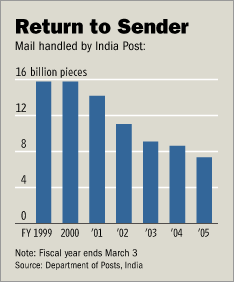
Q: How many people work at the world's largest post office, India Post?
A: About half.
Well, actually they work half days, finishing their deliveries by noon. Due to so much competition from UPS and FedEx, India Post has lost half of its business in recent year. From today's WSJ, "As Economy Zooms,India's Postmen Struggle to Adapt:"
India's vast postal service, the world's largest, highlights a little-understood feature of this nation's economic transformation. While India often draws criticism for its failure to sell its vast network of state-owned companies, the government has quietly been opening many of its agencies to blistering competition from private-sector rivals.
But as India lets its public sector get squeezed, it faces a big dilemma: What to do with these often huge and politically connected organizations during the painful transition period where they have to become competitive and profitable or extinct?
Once the pride of India's civil service, India Post and its predecessor, the British East India Co., controlled most mail delivery for centuries. But since a reform-minded government started allowing more competition in the 1990s, more-efficient private couriers have eaten deeply into India Post's business.
Monday, October 2, 2006
Income Tax Cuts Benefit All
An article from today's USA Today:
Americans of every income have benefited from a drop in federal income tax rates as Bush administration tax cuts enacted since 2000 took effect, an independent analysis of newly released IRS data shows.
For example, millions of lower-income Americans — those earning $25,000 annually or less — have been taken off the federal tax rolls. In 2000, 29 million tax returns had no federal tax owed. Four years later, the number rose to 43 million returns.
A taxpayer who earned $35,000 in 2000 would have paid 8.5% of that income -- $2,989 after credits -- in federal taxes; in 2004, federal taxes would have accounted for only 5% of that taxpayer's annual income, or $1,792 (a 40% decrease in tax burden).
But those earning $75,000 to $500,000 are shouldering a larger share of total taxes paid as millions more of them earn higher incomes and get hit with the Alternative Minimum Tax, the analysis also found.
At the higher end of the income brackets, a $1.75 million earner would have paid $513,625 in 2000 federal taxes, when the rate for that earning bracket was 29.35 percent; four years later, when the rate dropped to 25 percent, that earner would have paid $437,500 (a 14.8% cut in tax burden).
Further, the overall tax buden of higher income taxpayers increased. Taxpayers who earned between $100,000 and $200,000 in 2004 paid 22.5% of all federal taxes, up from 19.4% four years earlier. Those who earned between $200,000 and $500,000 in 2004 paid 18% percent of all federal taxes, up from 15.4% in 2000, the analysis showed.
The Market Creates Wealth and Miracles for All
From today's WSJ, an article by Johan Norberg titled "Humanity's Greatest Achievement," in defense of global capitalism.
Think for a moment about what this morning would have looked like if it were 150 years ago. You wouldn't have had electric light, running water or indoor sanitation. You couldn't have gone to work by car, bus or train. You couldn't have used a computer, which performs calculations in seconds that would take decades with pen and paper. In short, you would probably not have found this morning very comfortable or enjoyable -- if you had been alive to experience it. Back then, the global average for life expectancy was around 30 years.Amen.We tend to take our opportunities for granted, but our ancestors could not have imagined what we now have. In the last 100 years, we have created more wealth than in the 100,000 years before that, and not because we work more. To the contrary: In the last century, work hours have been halved in the Western world. It is because new ideas have made it possible for us to work smarter and find easier ways to satisfy our needs and demands.
The people we should thank are the innovators and entrepreneurs, the individuals who see new opportunities and risk exploring them -- the people who find new markets, create new products, think out new ways to handle commodities commercially, organize work in new ways, design new technology or transfer capital to more productive uses. The entrepreneur is an explorer, who ventures into uncharted territory and opens up the new routes along which we will all be traveling soon enough. Simply to look around is to understand that entrepreneurs have filled our lives with everyday miracles.
The ingratitude toward those who have given us almost everything seems strange. But perhaps there is a historical explanation. Wealth and innovation are recent phenomena.
Subscribe to:
Posts (Atom)


