Gallery
Showing posts with label 466. Show all posts

Friday, December 1, 2006

USD Slides, But It's Not All Bad

Yesterday, the dollar hit a 20-month low against the euro and a 14-year low against the pound. Over the past year, it has dropped 6.7% against a Federal Reserve index of seven major currencies.

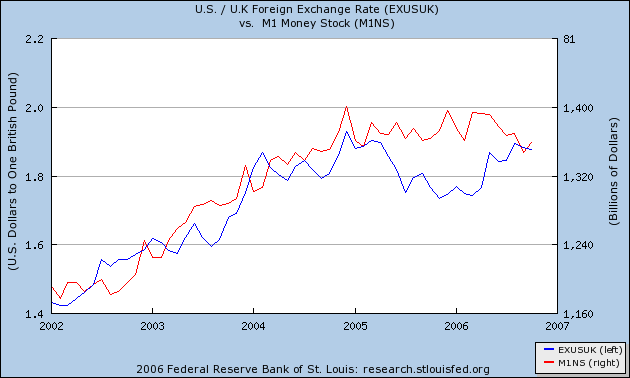
As the graph above shows, the appreciation of the British pound from about $1.40 to almost $2.00 over the last 4 years (left scale), and the accompanying fall of the USD, closely follows the increase in the supply of dollars, measured by M1 (right scale). Supply of dollars goes up, the value of the dollar goes down, and it takes more dollars to buy a British pound. Simple. It shoudn't be any surprise that the significant increase in the US M1 money supply, because of expansionary monetary policy in 2001-2004 (bringing the Fed Funds target rate from 6% in 2001 to 1% by 2004), has led to a decline in the value of the dollar.

A falling dollar might sound bad, but there are many benefits:

1. Higher stock returns overseas in dollars, because of the appreciation of foreign currencies, see my post below.

2. Increased demand for US goods and services, because of the appreciation of foreign currencies, see this story in today's WSJ: "Shopping as the Dollar Drops: Europeans Flock to U.S. for Deals While the Pound and the Euro Soar; Scoring iPods, Tiffany, Nike Sneakers."
A hot destination for European travelers this winter: Minnesota.

At a Holiday Inn near the Mall of America, the giant shopping center just outside Minneapolis, foreign tourists shopped so much this week that the hotel had to set aside four guest rooms to hold their suitcases after filling up its baggage-storage room.

Europeans are flocking to U.S. stores for Christmas shopping because the dollar's weakness makes the U.S. look like a bargain basement to them. The British pound yesterday hit a 14-year high against the dollar, and the euro has hovered around historic highs, too.
3. A weaker dollar could help the U.S. deflate its ballooning trade deficit by making American goods cheaper abroad and foreign goods pricier for Americans. It also could help Treasury Secretary Henry Paulson fend off what he considers an alarming rise in protectionist sentiment. See WSJ article here.

Shop Global, Think Global, Invest Global


From today's WSJ, an article titled "Dollar's Decline Boosts Overseas Returns: Money Pours Into Mutual Funds That Focus on Non-U.S. Stocks:" "Mutual-fund investors in the U.S. shipping their money overseas continue to have the wind at their backs. They are getting a lift from declines in the value of the dollar against other currencies that in some parts of the world have more than doubled the returns on their stock- and bond-fund investments."

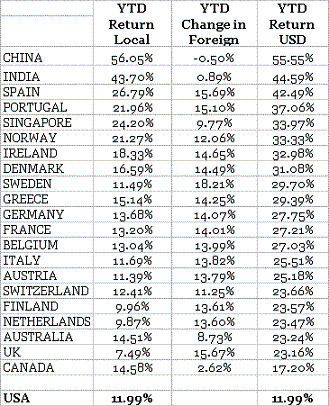
As the table above shows, YTD stock returns throughout Europe have been about double the US stock market return of about 12%, and have been boosted by the double-digit appreciation of the euro and pound during the year. YTD Dollar returns in China, India and Spain are 3-4 X times higher than the U.S. return.

An often overlooked and neglected advantage of globalization are the significant benefits from global investing. According to the graph above, a $10,000 investment over the last three years would have generated about an additional $4,500 for a US investor from investing overseas ($17,000) vs. investing in the U.S. ($12,500). Globalization not only give U.S. consumers access to the world's cheapest and best goods and services, but it also gives US investors access to the highest stock returns. Disucssions about the "benefits of trade" often overlook the benefits of international investments.

Dollar returns in Spain and India this year are more than 3.5X higher than the 12% in the U.S., and the 55.55% return in China is more than 4X the U.S. return. We hear a lot about losing U.S. jobs to India and China due to globalization and outsourcing, but we don't hear much about the significant benefits to U.S. investors from "outsourcing" investments to China and India and getting returns 3-4X higher than the U.S.

Think about it: We get goods from China at lower prices than domestic prices, we get services in India at lower wages than domestic wages, and we get stock returns in those countries 4X higher than in the U.S.? What more could we ask for?

And I can hear protests already that only "the rich" can benefit from 40-50% stock returns overseas, but that is not true. According to my analysis at
Morningstar, using its fundscreener, there are almost 200 no-load international stocks mutual funds that have minimum purchases of only $500! A $500 investment overseas three years ago would now be worth about $850!

My advice: Shop globally, invest globally, travel globally, eat globally, think globally.

Wednesday, November 29, 2006

Dollar Hits 20-Month Low vs. Euro

The euro reached a 20-month high against the dollar at $1.3210. Read about it in today's WSJ.

The Organization for Economic Cooperation and Development warned yesterday that a sharp appreciation of the euro against the dollar could stunt a euro-zone economy already expected to slow next year on the back of slower U.S. growth and domestic fiscal overhauls. A euro closer to $1.40 could prompt monetary policy makers and politicians to speak up.


Monday, November 27, 2006

Wal-Mart Goes to India

From today's WSJ, an article about Wal-Mart finalizing a joint venture with Indian telecommunications company Bharti Airtel (provides cell phone service to 24 million Indians) to to open a chain of hundreds of discount retail stores across the country.

India's booming retail market, estimated at about $200 billion, is currently dominated by more than 12 million mom-and-pop shops. Large, air-conditioned stores remain a rarity. Rising middle-class incomes and an increase in demand for branded products are driving the growth of retail business in India. Nevertheless, selling through company-owned network stores currently totals about $8 billion or less than 5% of market.

Wal-Mart Facts:

Wal-Mart has more than 2,700 stores in fourteen markets outside the U.S.: Argentina, Brazil, Canada, China, Costa Rica, El Salvador, Germany, Guatemala, Honduras, Japan, Mexico, Nicaragua, Puerto Rico, and the United Kingdom.

Wal-Mart's international stores employ more than 500,000 Wal-Mart associates, serving 49 million international customers each week.

Worldwide, more than 176 million people shop at Wal-Mart stores every week around the globe, proving that low prices is a message clearly understood in any language.

Thursday, November 23, 2006

Econ Bloggers: Slide-Rule Celebrities

Marginal Revolution mentions an article from today's LA Times Business Section, about how "economists who author blogs are drawing fans who see nothing dismal about the discipline." The article features the blog Marginal Revolution (Tyler Cowen and Alex Tabarrok at George Mason), and blogs by Nobel laureate Gary S. Becker and federal appeals court judge Richard A. Posner, former Harvard President Lawrence H. Summers, Harvard economist Greg Mankiw, and Chicago economist Steven Levitt (co-author of Freakonomics).

From the article:

Econo-fans are responding, Becker figures, because the blogs put important pocketbook issues into understandable language. Whereas former Federal Reserve Chairman Alan Greenspan had "Greenspeak" — the carefully convoluted jargon whose comprehensibility rivaled that of Klingon — the blogs connect economics to daily life.

"Most people are afraid of economics. It seems so technical," Becker said. "But what is surprising is that if you put economics in a simple enough phrase, people are very much interested in it."

Wednesday, November 22, 2006

Free Trade Works

From today's WSJ:

"Free trade is the most important single way to promote growth," Milton Friedman said in an interview a few weeks before his death. Simply put, markets and free trade work. For example:

A recent Global Insight analysis concludes that Wal-Mart's 1985-2004 expansion of sales resulted in a 9.1% drop in the price of food, a 4.2% drop in the price of other goods and commodities, and a 3.1% decline in consumer prices overall, saving the average working family about $2,329 per year. And with that came a net increase of 210,000 Wal-Mart jobs in 2004 alone.

The North American Free Trade Agreement has expanded total trade between the U.S, Canada, and Mexico by 172%. U.S. exports to Mexico have grown by 189% and to Canada by 111%. U.S. agricultural exports to Canada have doubled, to $10.6 billion from $5.3 billion, and to Mexico even more--to $9.4 billion from $3.6 billion. More than one million jobs were created in America by NAFTA.

Overall, 10.4% of the U.S. GDP in 2005 is the result of U.S. exports of goods and services. The Peterson Institute says that globalization boosts the U.S. economy $1 trillion annually, or about $10,000 per household. There is no question that trade both increases jobs in some areas and decreases them in others, both internationally and domestically. When cars replaced carriages, computers replaced typewriters, and E-ZPass replaced toll-takers in America, some jobs were lost and other were gained.